Mulch calculator: how many yards or bags do you need?
Measure each bed and pick a depth to get a shopping list: how many bags, or what to ask a landscape yard for. Most established beds need 2–3 in.
Enter your measurements
More options: Settling · Bag price · Bulk price …
- Mulch needed
- 1.85 cu yd (50 cu ft)
- If you order bulk, ask for
- 2 cu yd
- Area covered
- 200 sq ft
20 ft × 10 ft = 200 sq ft
200 sq ft × 3 in ÷ 12 = 50 cu ft ÷ 27 = 1.85 cu yd
50 cu ft ÷ 2 cu ft per bag = 25 bags
Bulk: 1.85 cu yd rounded up to the next ½ cu yd = 2 cu yd
- Same job in the other common size: 17 bags of 3 cu ft (13.5 and 9 bags per cubic yard).
Quick answers for common sizes
| Example | Answer |
|---|---|
| How much mulch for a 10×10 area | 0.93 cu yd |
| How much mulch for a 10×20 area | 1.85 cu yd |
| How much mulch for a new 200 sq ft bed at 4 inches | 2.47 cu yd |
| How much mulch for 1,000 sq ft | 9.26 cu yd |
| How much mulch for a 3×40 ft foundation bed | 1.11 cu yd |
| How much mulch for a 6 ft tree ring | 4 bags |
| How much mulch for 10 m² | 0.75 m³ |
Mulch needed by depth
| Depth | Mulch needed | Bags to buy |
|---|---|---|
| 1 in | 0.62 cu yd | 9 bags |
| 2 in | 1.23 cu yd | 17 bags |
| 3 in | 1.85 cu yd | 25 bags |
| 4 in | 2.47 cu yd | 34 bags |
| 6 in | 3.7 cu yd | 50 bags |
New beds with weeds to smother need 3–4 in. A cubic yard is 13½ bags of 2 cu ft — roughly a compact pickup bed filled level, or 5–6 wheelbarrow loads. Add your bag price, bulk price and delivery fee (under More options) to see which way is actually cheaper for this job.
How the mulch calculator works
Mulch is sold by volume, so the math is area × depth. Work the bed out in square feet, multiply by the depth in feet (inches ÷ 12), and you have cubic feet. Bulk suppliers sell by the cubic yard, which is 27 cubic feet — a box 3 ft on each side.
cubic feet = length (ft) × width (ft) × depth (in) ÷ 12
cubic yards = cubic feet ÷ 27
bags = cubic feet ÷ bag size (cu ft)
circle area = 3.1416 × (diameter ÷ 2)²
triangle area = base × height ÷ 2
A cubic yard fills 13.5 bags of 2 cu ft or 9 bags of 3 cu ft. In metric, 1 m³ is 1,000 litres, so it fills 20 bags of 50 L. The result starts with a plain shopping list: the bag count, and from about a yard up, the exact phrase to use when you call a landscape yard.
How deep should mulch be?
| Situation | Typical depth |
|---|---|
| Topping up last year’s mulch | 1–2 in (2.5–5 cm) |
| Established shrub and perennial beds | 2–3 in (5–7.5 cm) |
| New beds, or smothering weeds | 3–4 in (7.5–10 cm) |
| Around trees | 2–3 in, pulled a few inches back from the trunk |
| Wood-chip paths | 3–4 in, topped up yearly |
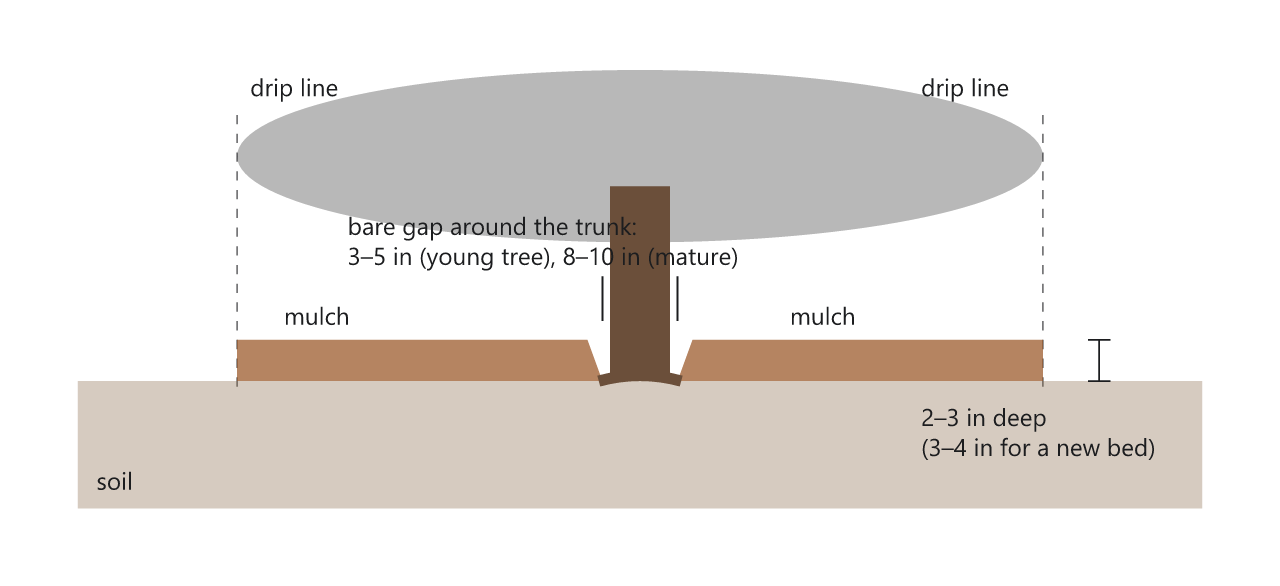
Penn State Extension’s mulching guide also points out that new mulch spread over old in successive years is the same as spreading too deep a layer at once — so measure what is already there before you buy. For tree rings, K-State Research and Extension suggests starting the mulch a few inches from the trunk and carrying it out at least 3 ft in every direction, farther if you can.
Measuring odd-shaped beds
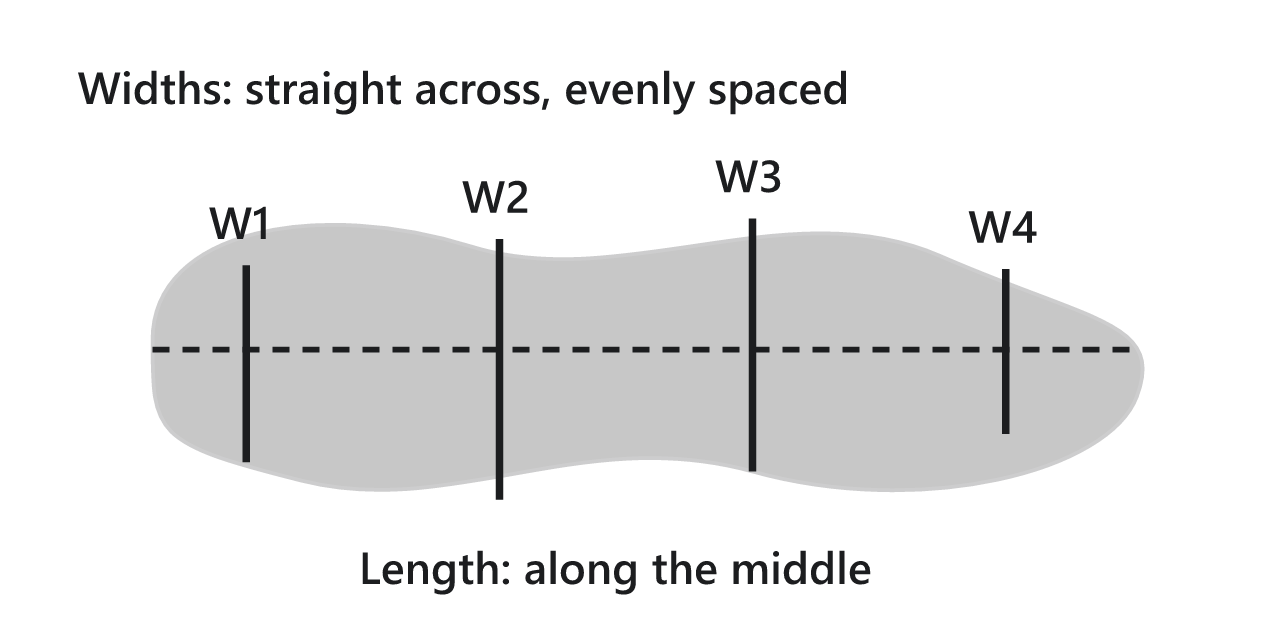
Few beds are neat rectangles. Pick Curvy bed and enter the length plus a few widths (add as many as the bed needs), or break the bed into rectangles, a circle and a corner triangle, run each one and press Add to project list — the list totals the yards, bags and cost for you, and adds a rounded bulk-order line. Several identical tree rings? Pick the circle and set How many of these. A 10–15% overestimate is harmless; running out halfway through a Saturday is not.
Worked examples by size
The common sizes are already worked out, each with its own quirks: a small How much mulch for a 10×10 area bed that fits in the car, a How much mulch for a 10×20 area planting where bulk starts to make sense, and a How much mulch for a 3×40 ft foundation bed strip along the house. For whole-yard jobs see How much mulch for 500 sq ft and How much mulch for 1,000 sq ft; for a first-year bed, How much mulch for a new 200 sq ft bed at 4 inches; for trees, How much mulch for a 6 ft tree ring; and in metric, How much mulch for 10 m².
Bags or bulk: where the break-even usually falls
Enter both prices and a delivery fee under More options and the calculator tells you which is cheaper for your job. Landscape yards generally sell in half- or whole-yard steps (0.5 or 1 m³ in metric), so the bulk cost is worked out on the rounded-up order, not the exact volume. If the yard has a minimum delivery, enter it too: below the minimum you pay for the minimum (or a short-load fee), and the calculator says how much will be left over. As a rough pattern, bags tend to win below about a yard (no delivery fee, no leftover pile), and bulk tends to win somewhere past two or three yards — but local prices and delivery charges move that line a lot.
Practical tips
- Check how much old mulch is left before buying. If there is 1–2 in still there, you only need to top up to 3 in.
- Keep mulch off tree trunks and plant stems. Piled against bark ("volcano mulching"), it holds moisture where you don’t want it.
- Bagged mulch is compressed and fluffs up a little; bulk mulch settles after the first rain. The estimate assumes no settling; if you want the bed to look full all summer, add 5–10% under Extra for settling.
- Wood mulch left on the surface doesn’t rob your plants of nitrogen — Colorado State University Extension notes the tie-up happens when wood chips are mixed into the soil, not laid on top.
- Past roughly 3 cubic yards, bulk delivery is usually worth pricing out — but compare the delivered price, not the per-yard price.
For coverage per yard and per bag at every depth, see the mulch coverage chart, and for the money side, bagged vs bulk mulch. New to terms like bulk and cubic yard? See words you’ll hear at the yard. Using pine needles instead? The pine straw calculator works in bales.
What you’ll need
- Wheelbarrow (6 cu ft class)Mid-range price
Most home wheelbarrows hold 4–6 cubic feet — so a cubic yard of mulch is five or six trips. Two wheels are steadier on soft ground.
See options on Amazon (opens in a new tab) - Mulch / manure forkBudget price
Many tines grip shredded mulch and compost that slide off a shovel. Much faster for spreading bulk mulch.
See options on Amazon (opens in a new tab) - Bow rake / landscape rakeBudget price
Steel tines for spreading gravel and soil and leveling it flat. The flat back of a bow rake doubles as a leveling tool.
See options on Amazon (opens in a new tab) - Landscape fabric (woven or heavy non-woven)Budget price
Separates stone from soil under gravel and rock. Less useful under wood mulch, which breaks down into soil on top of it anyway.
See options on Amazon (opens in a new tab) - No-dig landscape edgingBudget price
Plastic edging pinned with spikes — keeps mulch in beds and grass out. Fine for mulch; too flimsy for gravel paths.
See options on Amazon (opens in a new tab)
As an Amazon Associate we earn from qualifying purchases. Links to products are affiliate links — they cost you nothing extra and help keep these calculators free.
Frequently asked questions
Why does the bag size change the number of mulch bags so much?
Because a cubic yard is 27 cubic feet: 13.5 bags of 2 cu ft but 9 of 3 cu ft. Every size is listed on How many bags of mulch are in a cubic yard.
How much area does a cubic yard of mulch cover?
About 324 sq ft at 1 in deep, 162 sq ft at 2 in, 108 sq ft at 3 in, and 81 sq ft at 4 in.
How much mulch do I need for a 10 × 10 area?
About 0.93 cubic yards (13 bags of 2 cu ft) at 3 in deep. The 2 in and 4 in figures are on How much mulch for a 10×10 area.
Is it cheaper to buy mulch in bags or in bulk?
Bulk is usually cheaper per yard, but delivery fees and minimum orders change the math. For small jobs — roughly under 2 or 3 yards — bags are often close in total cost and far more convenient. Put your bag price, bulk price, delivery fee and the yard’s minimum into the calculator and it tells you which wins.
How much mulch for several tree rings?
Choose the circle shape, enter one ring’s diameter and depth, and set how many. One 6 ft ring at 3 in takes 4 bags of 2 cu ft; the multi-ring numbers are on How much mulch for a 6 ft tree ring.
Related guides
Sources
- Penn State Extension — Mulching Landscape Trees (opens in a new tab) — 2–4 in of organic mulch and no more (less on poorly drained soil); keep it off the trunk; new mulch over old counts toward the depth.
- University of Minnesota Extension — Mulching for soil and garden health (opens in a new tab) — 2–4 in balances weed suppression with soil aeration.
- Colorado State University Extension — Mulching (opens in a new tab) — Wood chips and bark on the surface do not tie up soil nitrogen; mixing them into soil can.
- K-State Research and Extension, Johnson County — How to Mulch Trees (opens in a new tab) — Start mulch 3–6 in from the trunk and carry it out at least 3 ft in all directions; 6 ft is better.
- Messina’s — How much mulch fits in a truck bed? (opens in a new tab) — About 1.5 cu yd in a 5.5 ft pickup bed, about 2 in a 6.5 ft bed, 2.5–3 in an 8 ft bed.
- Harbor Soils — Cubic yard calculator and formula (opens in a new tab) — Topsoil and bark settle about 10% in the first season.
- Gravel Monkey — How many tons of gravel in a dump truck? (opens in a new tab) — Typical payloads: single-axle about 6–10 tons, tandem 12–16, tri-axle 18–25; gravel hits the weight limit before the bed is full.